(804) 353-4500tswinfo@tswinvest.com
You are leaving TSW
You are now leaving the TSW website. This link is provided as a convenience, and Thompson, Siegel & Walmsley is not responsible for the content provided on your destination site.
You are now leaving the TSW website. This link is provided as a convenience, and Thompson, Siegel & Walmsley is not responsible for the content provided on your destination site.

International equities significantly outperformed U.S. stocks in 2025. The MSCI EAFE Index of developed markets outside North America returned 31.2% for the year, compared with a 17.9% return for the S&P 500® Index. Most of the difference in 2025 was contributed by a decline in the foreign exchange value of the U.S. Dollar. Adjusting for that effect, the EAFE Index gained 20.6% in local currency terms, narrowly edging out the U.S. benchmark.
Changes in the foreign exchange value of the U.S. Dollar have had a significant impact on short-term returns of foreign securities for Dollar-based investors. The Dollar strengthened significantly in 2024, for example, depressing returns from foreign stocks by 7.5 percentage points, a move that was reversed in 2025. This two-year period illustrates how currency risk—the uncertainty caused by exchange rate movements—is an important short-term factor for investors holding foreign securities. Exchange rates are influenced by a myriad of factors, including interest rates, trade policy and market psychology, and because of this they are exceptionally hard to predict—although there is no lack of annual guessing.
Emerging markets currencies also gained versus the U.S. Dollar in 2025, boosting returns from EM stocks. Emerging markets currencies can be exceptionally volatile, however, adding uncertainty, and some might say opportunity, to EM investing.
Foreign exchange rates can be an important factor in assessing the value and short-to-medium-term outlook for a particular company. For example, many European companies tempered their earnings guidance in 2025 because profits earned in the U.S. were worth less when translated into their reporting currency. A weak currency, on the other hand, might create inflation, hurting consumer purchasing power or pushing up interest rates and input costs.
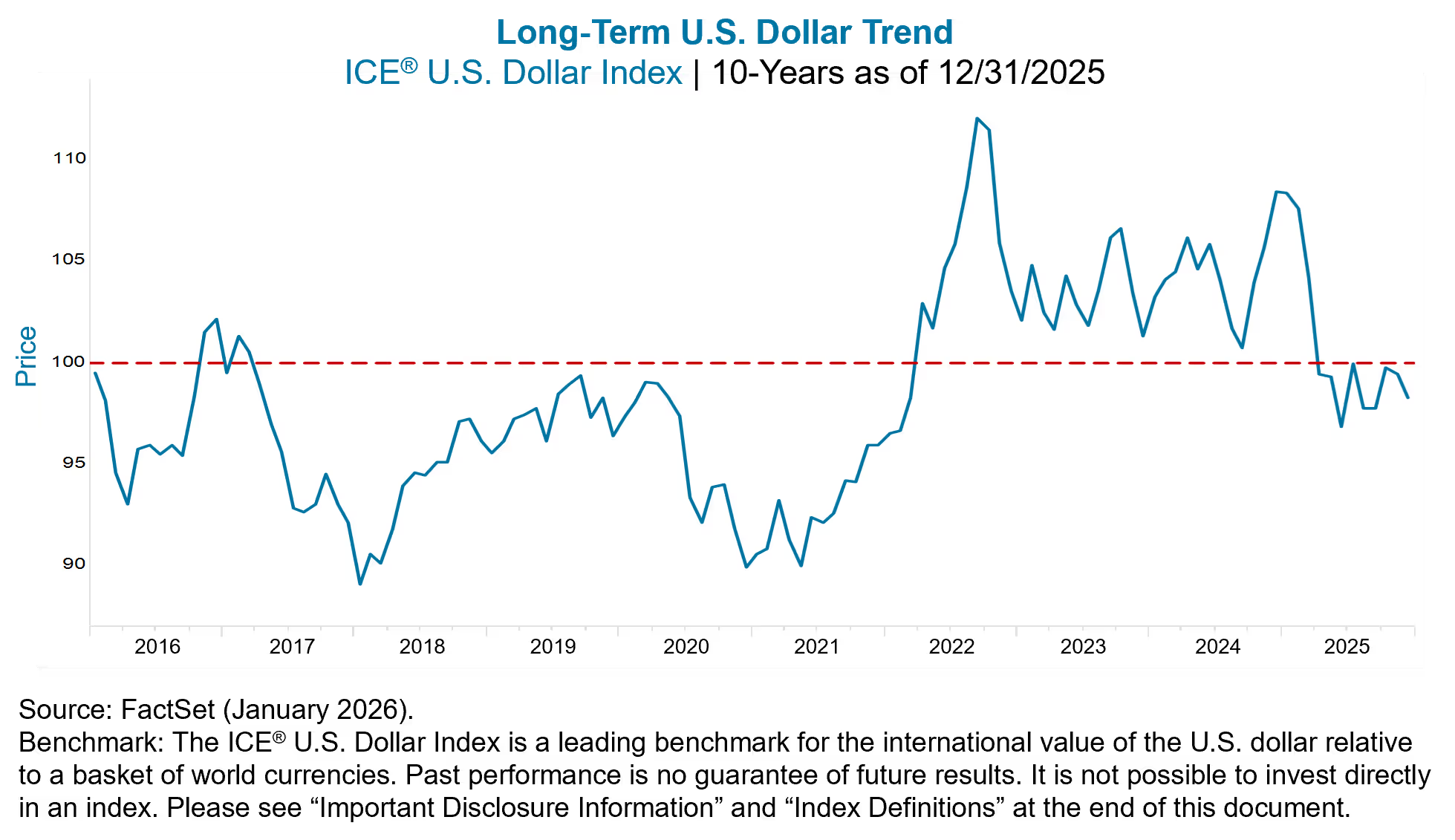
Over a longer time horizon, the dramatic effects of exchange rate movements tend to flatten out. As the chart below shows, the U.S. Dollar index, which measures the value of the Dollar versus a basket of major global currencies, has fluctuated across a wide range, but ended 2025 almost exactly where it began 2016. An investor who held developed country securities through the last decade surely felt some currency turbulence but didn't gain or lose returns due to exchange rates over the whole period.
TSW is not in the business of forecasting exchange rates, and while we don't ignore them, we don't use currency predictions as the basis for investments. Currency will undoubtedly play a role in returns from foreign stocks in 2026, but we won't chance a guess. Instead, we will continue to focus on valuation, business fundamentals like cash flow and capital allocation, and a patient time horizon across which positive change can drive strong returns, overwhelming the short-term effects of exchange rate movement.
Published January 2026
IMPORTANT DISCLOSURE: This commentary is intended for informational purposes only and does not constitute a complete description of our investment services, analysis, or performance. This commentary is in no way a solicitation or an offer to sell securities or investment advisory services. The expressed views and opinions contained herein are for informational purposes only, are based on current market conditions, and are subject to change without notice. Although information, opinions, and statistics contained herein have been obtained from sources believed to be reliable and are accurate to the best of our knowledge, Thompson, Siegel & Walmsley LLC (“TSW”) cannot and does not guarantee the accuracy, validity, timeliness, or completeness of such information and statistics made available to you for any particular purpose. This commentary should not be considered as investment advice or a recommendation of any particular security, strategy, or investment product. Past performance is not indicative of future results. No part of this commentary may be reproduced in any form, distributed, or referred to in any other publication, without express written permission of TSW.
GENERAL ECONOMIC & MARKET COMMENTARY DISCLOSURE: Comments and general market related projections are based on information available at the time of writing and believed to be accurate; are for informational purposes only, are not intended as individual or specific advice, may not represent the opinions of the entire firm and may not be relied upon for future investing. Certain information contained in this material represents or is based upon forward-looking statements, which can be identified by the use of terminology such as “may”, “will”, “should”, “expect”, “anticipate”, “target”, “project”, “estimate”, “intend”, “continue” or “believe” or the negatives thereof or other variations thereon or comparable terminology. Due to various risks and uncertainties, actual events or results or the actual performance of an Account may differ materially from those reflected or contemplated in such forward-looking statements. Investors are advised to consult with their investment professional about their specific financial needs and goals before making any investment decisions. Past performance is not indicative of future results.
HOLDINGS DISCLOSURE: The information provided in this report should not be considered a recommendation to purchase or sell any particular security. There is no assurance that any securities discussed herein will remain in an account’s portfolio at the time you receive this report or that securities sold have not been repurchased. The representative account has/may change over time. The securities discussed may not represent an account’s entire portfolio and in the aggregate may represent only a small percentage of the portfolio’s holdings. It should not be assumed that any of the securities transactions or holdings discussed were or will prove to be profitable, or that the investment recommendations or decisions made in the future will be profitable or will equal the investment performance of the securities discussed herein. Please note that this strategy invests in securities outside of the Index. A complete list of every holding and every holding’s contribution to performance during the period and the methodology of the contribution to return is available by contacting us at TSWinfo@tswinvest.com.
EQUITY SECURITIES RISK: Equity securities generally have greater risk of loss than debt securities. Stock markets are volatile, and the value of equity securities may go up or down, sometimes rapidly and unpredictably. The value of equity securities fluctuates based on real or perceived changes in a company’s financial condition, factors affecting a particular industry or industries, and overall market, economic and political conditions. If the market prices of the equity securities owned by the strategy fall, the value of your investment in the strategy will decline. Your portfolio may lose its entire investment in the equity securities of an issuer. A change in financial condition or other event affecting a single issuer may adversely impact securities markets as a whole.
INTERNATIONAL INVESTING RISK: Investments in global/international markets involve special risks not associated with U.S. markets, including greater economic, political and currency fluctuation risks, which are likely to be even higher in emerging markets. In addition, foreign countries are likely to have different accounting standards than those of the U.S.
PRINCIPAL RISK: Risk is inherent in all investing. Many factors and risks affect performance. The value of your investment, as well as the amount of return you receive on your investment, may fluctuate significantly day to day and over time. You may lose part or all of your investment in your portfolio or your investment may not perform as well as other similar investments. An investment in the strategy is not a bank deposit and is not insured or guaranteed by the Federal Deposit Insurance Corporation or any other government agency. You may lose money if you invest in this strategy.
VALUE INVESTING RISK: The prices of securities TSW believes are undervalued may not appreciate as anticipated or may go down. The value approach to investing involves the risk that stocks may remain undervalued, undervaluation may become more severe, or perceived undervaluation may actually represent intrinsic value. Value stocks as a group may be out of favor and underperform the overall equity market for a long period of time, for example, while the market favors “growth” stocks.
For additional information regarding potential risks to your investment please see risk disclosures in our Form ADV Part 2A found here https://www.tswinvest.com.
INDEX DEFINITIONS:
S&P 500® Index: The Index measures the performance of the large-cap segment of the market. Considered to be a proxy of the U.S. equity market, the Index is composed of 500 constituent companies.
MSCI EAFE Index: The MSCI EAFE Index is an equity index which captures large and mid cap representation across 21 Developed Markets countries around the world, excluding the U.S. and Canada. The Index covers approximately 85% of the free float adjusted market capitalization in each country.
ICE® U.S. Dollar Index: The ICE® U.S. Dollar Index is a leading benchmark for the international value of the U.S. dollar relative to a basket of world currencies.
©2026 Thompson, Siegel & Walmsley LLC (“TSW”). TSW is an investment adviserregistered with the SEC. Registration does not imply a certain level of skillor training. All information contained herein is believed to be correct butaccuracy cannot be guaranteed. TSW and its employees do not provide tax orlegal advice. Past performance is not indicative of future results; pastperformance does not guarantee future results, and other calculation methodsmay produce different results. There is the possibility of loss of principalvalue. Certain GIPS®disclosures are provided on TSW’s website at www.tswinvest.com, others are available upon request. TSW is atrademark in the United States Patent and Trademark Office.
Subscribe to receive the latest news and updates

You are now leaving the TSW website. This link is provided as a convenience, and Thompson, Siegel & Walmsley is not responsible for the content provided on your destination site.
You are now leaving the TSW website. This link is provided as a convenience, and Thompson, Siegel & Walmsley is not responsible for the content provided on your destination site.
You are now leaving the TSW website. This link is provided as a convenience, and Thompson, Siegel & Walmsley is not responsible for the content provided on your destination site.