(804) 353-4500tswinfo@tswinvest.com
You are leaving TSW
You are now leaving the TSW website. This link is provided as a convenience, and Thompson, Siegel & Walmsley is not responsible for the content provided on your destination site.
You are now leaving the TSW website. This link is provided as a convenience, and Thompson, Siegel & Walmsley is not responsible for the content provided on your destination site.

The diversification argument for Emerging Market ("EM") equities has traditionally assumed exposure across roughly two dozen countries and well over a thousand companies. On paper, that's still true: the MSCI Emerging Markets Index spans just under 1,200 constituents across 24 countries. Underneath the headline numbers, however, the index has become increasingly concentrated - and has changed shape as it has done so, as shown below by the evolving cumulative weight of the top five index constituents over the last 20 years:
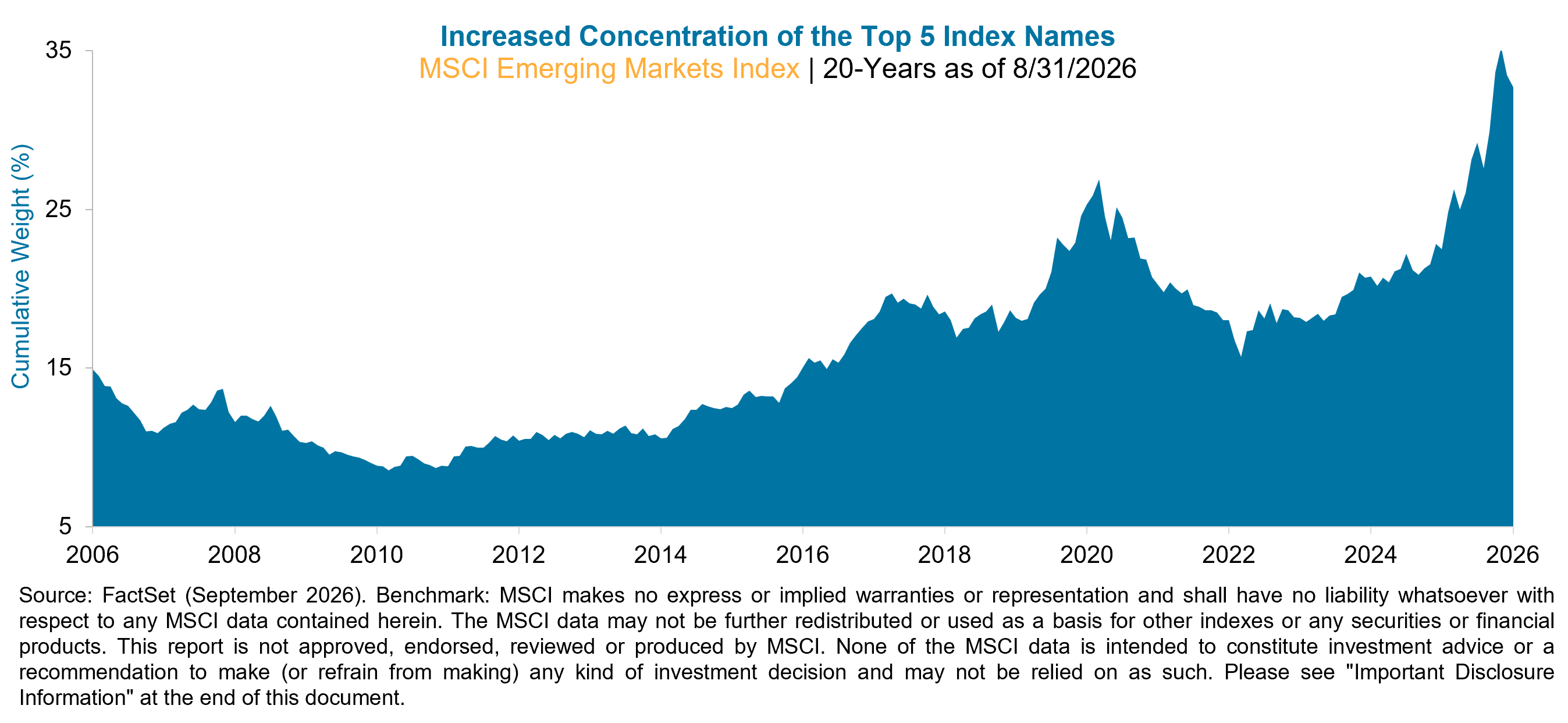
This is partly attributable to sustained foreign flows in recent years into select economies and, more specifically, in select securities - flows we believe to be highly cyclical in nature. The evolution of the index can have direct implications for how investors gain exposure to the asset class. Today, an investment in a passive, market-cap-weighted index has 42% concentration in the Information Technology sector. This allocation can be further refined into a handful of Taiwanese and Korean semiconductor manufacturers. That is not criticism of those companies, but it does suggest the index may no longer be a proxy for broad emerging market growth in the way it once was, particularly if the duration of the artificial intelligence capital expenditure cycle proves to be shorter than investors might currently expect.
TSW’s Emerging Markets strategy considers benchmark awareness to be a risk input, not a return target. We do not typically size individual positions to replicate a sector or country weight in the benchmark, though our portfolios do operate within +/-10% relative sector and country weighting guardrails designed to limit how far aggregate exposures can drift from the benchmark as a risk control. We also monitor correlation and concentration relative to the benchmark as two inputs, among several, into buy, trim, and exit decisions. For example, two holdings, each attractive on its own independent merits, can together represent a much larger and unintended bet on a single commodity, currency, or macroeconomic factor, such as the AI capex cycle, than either position was meant to represent on its own. We seek to avoid such unintended bets.
When managing our Emerging Markets strategy, we seek to maintain diversity in the types, sectors, countries, and holding period profiles of the ideas we hold. In our view, a concentrated portfolio built entirely around a single type of capital-cycle is a bet on that one setup, regardless of how each individual name is underwritten. We do not attempt to time markets, forecast macroeconomic variables, or express top-down country or sector calls through security selection. Our conviction is bottom-up and company-specific.
For investors evaluating EM exposure today, the practical takeaway in our view is not that passive vehicles are wrong, but that they may no longer offer one-stop shopping for investors seeking broad emerging markets exposure. A market-cap-weighted index and a diversified EM allocation are not automatically the same thing, and the gap between them has widened as flows have concentrated into a narrower set of countries, sectors, and capital-cycle stories. We believe the more durable path is to treat the benchmark as a reference point for risk, not a template for construction. We seek to build bottom-up exposure name by name, around distinct businesses and cycles, rather than accepting whatever concentration the index has accumulated. This approach will not always keep pace, especially when a single theme dominates index returns. We accept that as long-term investors - not as a drawback, but as confirmation of maintaining consistent investment discipline.
IMPORTANT DISCLOSURE: This commentary is intended for informational purposes only and does not constitute a complete description of our investment services, analysis, or performance. This commentary is in no way a solicitation or an offer to sell securities or investment advisory services. The expressed views and opinions contained herein are for informational purposes only, are based on current market conditions, and are subject to change without notice. Although information, opinions, and statistics contained herein have been obtained from sources believed to be reliable and are accurate to the best of our knowledge, Thompson, Siegel & Walmsley LLC (“TSW”) cannot and does not guarantee the accuracy, validity, timeliness, or completeness of such information and statistics made available to you for any particular purpose. This commentary should not be considered as investment advice or a recommendation of any particular security, strategy, or investment product. Past performance is not indicative of future results. No part of this commentary may be reproduced in any form, distributed, or referred to in any other publication, without express written permission of TSW.
GENERAL ECONOMIC & MARKET COMMENTARY DISCLOSURE: Comments and general market related projections are based on information available at the time of writing and believed to be accurate; are for informational purposes only, are not intended as individual or specific advice, may not represent the opinions of the entire firm and may not be relied upon for future investing. Certain information contained in this material represents or is based upon forward-looking statements, which can be identified by the use of terminology such as “may”, “will”, “should”, “expect”, “anticipate”, “target”, “project”, “estimate”, “intend”, “continue” or “believe” or the negatives thereof or other variations thereon or comparable terminology. Due to various risks and uncertainties, actual events or results or the actual performance of an Account may differ materially from those reflected or contemplated in such forward-looking statements. Investors are advised to consult with their investment professional about their specific financial needs and goals before making any investment decisions. Past performance is not indicative of future results.
INTERNATIONAL INVESTING RISK: Investments in global/international markets involve special risks not associated with U.S. markets, including greater economic, political and currency fluctuation risks, which are likely to be even higher in emerging markets. In addition, foreign countries are likely to have different accounting standards than those of the U.S.
EQUITY SECURITIES RISK: Equity securities generally have greater risk of loss than debt securities. Stock markets are volatile, and the value of equity securities may go up or down, sometimes rapidly and unpredictably. The value of equity securities fluctuates based on real or perceived changes in a company’s financial condition, factors affecting a particular industry or industries, and overall market, economic and political conditions. If the market prices of the equity securities owned by the strategy fall, the value of your investment in the strategy will decline. Your portfolio may lose its entire investment in the equity securities of an issuer. A change in financial condition or other event affecting a single issuer may adversely impact securities markets as a whole.
PRINCIPAL RISK: Risk is inherent in all investing. Many factors and risks affect performance. The value of your investment, as well as the amount of return you receive on your investment, may fluctuate significantly day to day and over time. You may lose part or all of your investment in your portfolio or your investment may not perform as well as other similar investments. An investment in the strategy is not a bank deposit and is not insured or guaranteed by the Federal Deposit Insurance Corporation or any other government agency. You may lose money if you invest in this strategy.
VALUE INVESTING RISK: The prices of securities TSW believes are undervalued may not appreciate as anticipated or may go down. The value approach to investing involves the risk that stocks may remain undervalued, undervaluation may become more severe, or perceived undervaluation may actually represent intrinsic value. Value stocks as a group may be out of favor and underperform the overall equity market for a long period of time, for example, while the market favors “growth” stocks.
INDEX DEFINITION: MSCI Emerging Markets Index: The MSCI Emerging Markets Index captures large and mid cap representation across 24 Emerging Markets (EM) countries. The Index covers approximately 85% of the free float-adjusted market capitalization in each country.
Thompson, Siegel & Walmsley LLC (“TSW”) is an investment adviser registered with the U.S. Securities and Exchange Commission. Registration does not imply a certain level of skill or training. More information about TSW's investment advisory services can be found in its Form ADV Part 2 and/or Form CRS, which are available upon request.
For additional information regarding potential risks to your investment please see risk disclosures in our Form ADV Part 2A found here https://www.tswinvest.com.
Subscribe to receive the latest news and updates

You are now leaving the TSW website. This link is provided as a convenience, and Thompson, Siegel & Walmsley is not responsible for the content provided on your destination site.
You are now leaving the TSW website. This link is provided as a convenience, and Thompson, Siegel & Walmsley is not responsible for the content provided on your destination site.
You are now leaving the TSW website. This link is provided as a convenience, and Thompson, Siegel & Walmsley is not responsible for the content provided on your destination site.